


#KateBriggs24 Weeks 10 & 11
This Little Art, p. 207-251, Sessions of Jan. 19&26 and Feb. 2&9

Hello everyone! Tomorrow (Saturday) is our next video call, and we’re looking forward to seeing those who can make it.
Click here to join the meeting beginning on Saturday, March 16th, at 12pm PDT / 3pm EDT / 7pm GMT.
If the meeting goes longer than an hour, then click here for the second part. We won’t get cut short this time!
All are welcome, regardless of how much or how little of the reading you have done. The meeting will be an informal chat — no pressure, no judgment, just enthusiasm for the brilliant Kate Briggs and the extremely odd and also brilliant Roland Barthes.
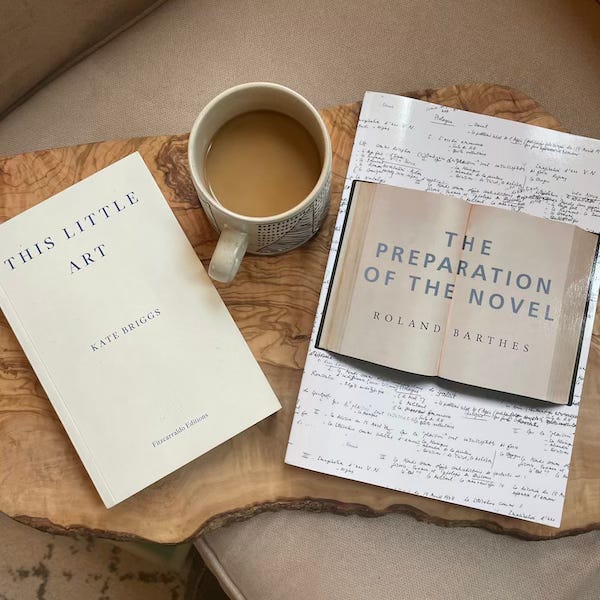
This will be a short newsletter and will cover the next two weeks because the next two weeks will be busy ones for me. As always, feel free to share your thoughts on the reading.
Schedule
Here’s our schedule for Week 10:

And our schedule for Week 11:

Resources and Links
On p. 242 of This Little Art, Briggs mentions a column by Tim Parks in the New York Review of Books called “The Translation Paradox.”
If you are becoming as obsessed with Barthes as I am, you might want to know about available biographies. The person who runs the Barthes Studies account on Bluesky is an amazing fount of knowledge, and when I asked for opinions on biographies, he delivered. He recommended Tiphaine Samoyault’s Barthes: A Biography (translated by Andrew Brown) as the best all-around work because of Samoyault’s access to archives that earlier biographers didn’t have. But he says that the others available are also good. They include Louis-Jean Calvet’s Roland Barthes: A Biography and Andy Stafford’s Roland Barthes, Phenomenon and Myth: An Intellectual Biography. Andy Stafford also wrote a short biography of Barthes as part of a “Critical Lives” series from Reaktion Books.
Check out Catherine Eaton’s Bluesky post on David Hinton’s book Awakened Cosmos: The Mind of Classical Chinese Poetry, which discusses the poetry of Tu Fu. She posted a page from the book on “wu-wei,” which Barthes writes about so frequently.
Check out Kim’s website with lots of resources and our full schedule.
I’ll leave you with this post from Nicholas Greco with a Barthes quotation that resonated with a lot of readers this week.

Thank you all for your company and your comments!
Find Kim on Twitter, Bluesky, and Instagram*
Find Rebecca on Twitter, Bluesky, and Instagram*
*Our Instagram accounts are locked, but we welcome bookish friend requests.
This Little Art, p. 207-211: I appreciate Briggs's recognition of the power a translator has , particularly when translating into English -- how it's possible to do violence to the original writing. And how it's possible to learn nothing from translation work, to remain unchanged and unmoved. But also, that translation is a chance of "being taught by the other's writing," to become a different reader. I like her parenthetical question, "is it useful to think of these activities in terms of progress?" I DO tend to think in terms of progress, but what goal am I working toward? As she says, the phrase "thorough-going mastery" is unrecognizable. How do you measure that? And I LOVE her question, "when could anyone, any reader or writer, consider themselves adequately pre-qualified to undertake the translation of, say, a 730-page novel set in a sanatorium?" At some point, we have to just begin? So why not begin now, where we are?
Hi there, sorry that I won’t be able to join tonight as inconveniently we have some friends coming for dinner! I am deep in The Preparation at present and getting quite worried about my notebooks and how I decide what to write in them. Photos may follow. Enjoy your discussion. I hope to join you next time